
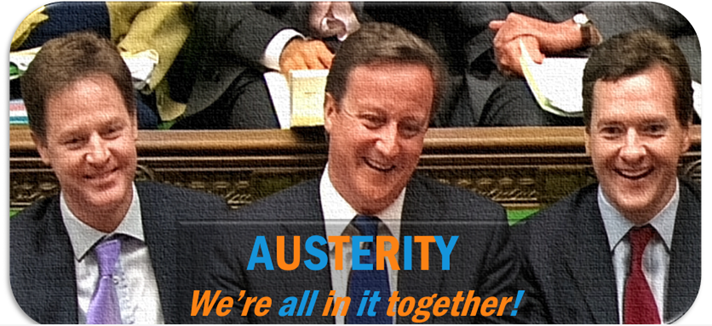
When David Cameron and Nick Clegg’s coalition government came to power in 2010, we were told there was only one possible way forward. The Coalition Leaders both promoted austerity as the ONLY and unavoidable option to recover the country following the 2008 global financial crash.
Cameron and Clegg sought to invoke a kind of Dunkirk spirit—urging the country to pull together, to accept hardship in the belief that we were “all in it together”. But that claim was not only untrue; it was deliberately misleading.
That deceit was perhaps unsurprising from a Conservative Prime Minister. What was far more disappointing was seeing it endorsed by a Liberal Democrat leader, exercising power for his party for the first time in decades.
What Cameron and Osborne were actually doing—while Clegg proved either unwilling or unable to challenge it—was using the moment to pursue a long-standing ideological goal: shrinking the state. That was a political choice, not an economic inevitability. Other options were available. In fact, the post-2008 approach taken by Gordon Brown, focused on stimulus and investment, was broadly followed by most G8 countries, many of whom actively sought his advice. By 2010, the UK economy was beginning to recover. Under austerity, that recovery faltered.
At the time, I was working for a charity and regularly visiting education departments within county councils. These teams were subjected to savage funding cuts—many reduced from around 70 staff to just 15 almost overnight, with no corresponding reduction in responsibilities. The same pattern was evident in community nursing. Friends and former colleagues saw staffing slashed and complex, preventative, human-centred work “rationalised” by bean counters in the pursuit of short-term savings. Complex, highly skilled, emotionally sensitive services were reduced to box-ticking exercises, used to justify further cuts.
This experience was mirrored across the civil service, where my husband worked, and I have little doubt it was repeated throughout much of the public sector.
At the same time, pay was frozen and recruitment restricted. For many public sector workers, there were to be no meaningful pay rises for a decade or more. The private sector also suffered—particularly businesses reliant on contracts with an increasingly cash-strapped state sector.
Meanwhile, the gap between rich and poor widened more sharply in the UK than in comparable countries, while productivity continued to lag. It is worth saying clearly that poor productivity is not about “lazy workers”; it is overwhelmingly about chronic underinvestment.
So no—we were never all in it together.
Nowhere is this clearer than in the NHS. Years of underinvestment and austerity transformed a service that in 2010 guaranteed treatment within 18 weeks, and enjoyed the highest public satisfaction ratings in its history, into the crisis-ridden system we see today. Covid is often used to obscure this decline, but the direction of travel was already firmly set long before the pandemic struck.
Then came Brexit. David Cameron’s reckless mis-handling of the issue resulted in a very narrow referendum outcome that saw the country literally vote to shoot itself in the foot, leaving the country paying a heavy price. Thousands of EU workers were lost from the NHS and social care. Businesses faced increased costs, reduced access to markets, and greater uncertainty. The economic damage was and is huge and continues to be felt.
So, over the past fifteen years, UK workers have experienced stagnant wages, rising workloads, and declining investment in their workplaces. We are working harder and longer for less. Free time has shrunk. Life’s small rewards—holidays, rest, and a sense of security—have become increasingly unaffordable.
And when the strain becomes overwhelming, when it manifests as mental or physical ill health, too many people find that they cannot access the timely care they need.
Of course, those with money have options. They can buy healthcare. They can pay for education they believe will best serve their children. They can still afford a reliable car and a family holiday each year.
But that only underlines the point: we were never all in it together. And the gap today is starker than at any time since the early part of the last century.
Keir Starmer was elected on a promise of a ten-year plan for national renewal. He made no claim about quick or easy fixes, and he warned that things would get worse before they got better. Yet unlike the widespread acceptance of austerity in 2010, this honest message—of a long, difficult road back to prosperity—has met with impatience from a media and public desperate for change.
The reality is this: there are no magic wands. Different choices in 2010 could have left us more resilient, more prosperous, and more genuinely in it together. But those choices were not made.
So before casting your vote in May, think carefully. A recovery that truly works for everyone will take time—and we should all be deeply wary of billionaire funded snake-oil salesmen who seek to promote fear focussed on false scapegoats and promise quick fixes for us all.
Cllr Alison Cornell
County Councillor for Langley Green and Ifield East